
Invention about an assistive device for tooth growth stimulation and jaw regeneration
Description
In the main definition of the application 1 of the invention we are talking about an assistive device (adjuvant) for tooth growth stimulation (to encourage the growth of teeth) and jaw regeneration.
Similar assistive (adjuvant) devices for jaw regeneration are known from the patents DE 43 02 709 C1 and DE 91 15 341 U1, and, in both cases, side parts are adjacent to the gingiva (gums) and fix (fix in the position of) the bone material necessary for the bone in the area (place) of regeneration.
On the contrary, the object of the invention is giving an opportunity for regeneration without the initially provided bone material.
This is permitted according to the features given in the application (claim) 1.
Advantages of the invention are given in the subsections of the applicatoin.
Thus, the invention differs from the modern technological level by characterising itself by the fact of being struck in a continuous manner with needles and, in this manner, achieving activation of the gingiva (gums) and of the jaw.
After extended usage there is a possibility of recovery. Through 1 millimetre length of the needles the intensive action is achieved.
Particularly, beneficial effect is achieved given one millimetre needle distance.
Simple production of assistive (adjuvant) device guaranteed by the fact that seperate needles compose one unit with the side parts of the dental prosthetic material.
The examples of the drawings demonstrate how the invention appears in practice.
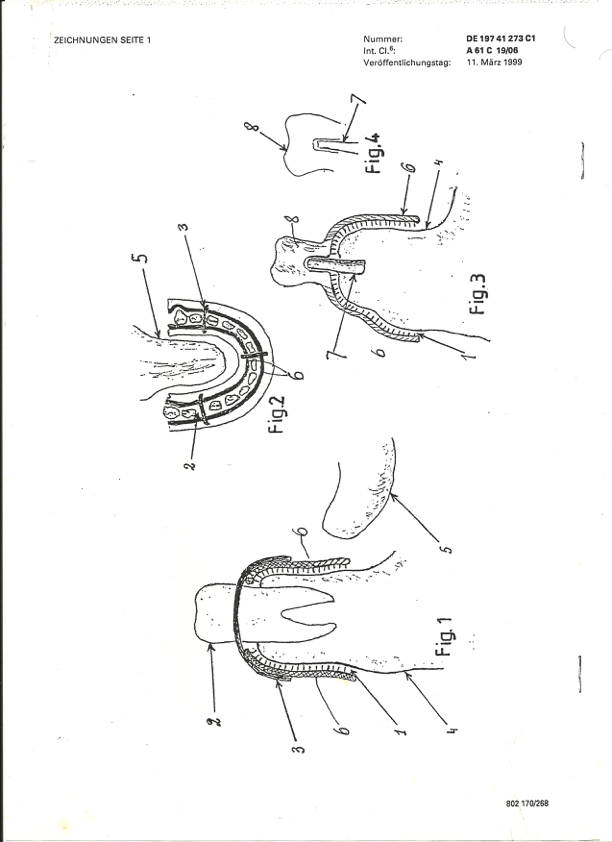
Shown:
Fig. 1 – cross section in the first examplary embodiment (execution).
Fig.2 - Top view of this type of execution.
Fig.3 – Second example of execution.
Fig.4 – Modification of the second example of execution.
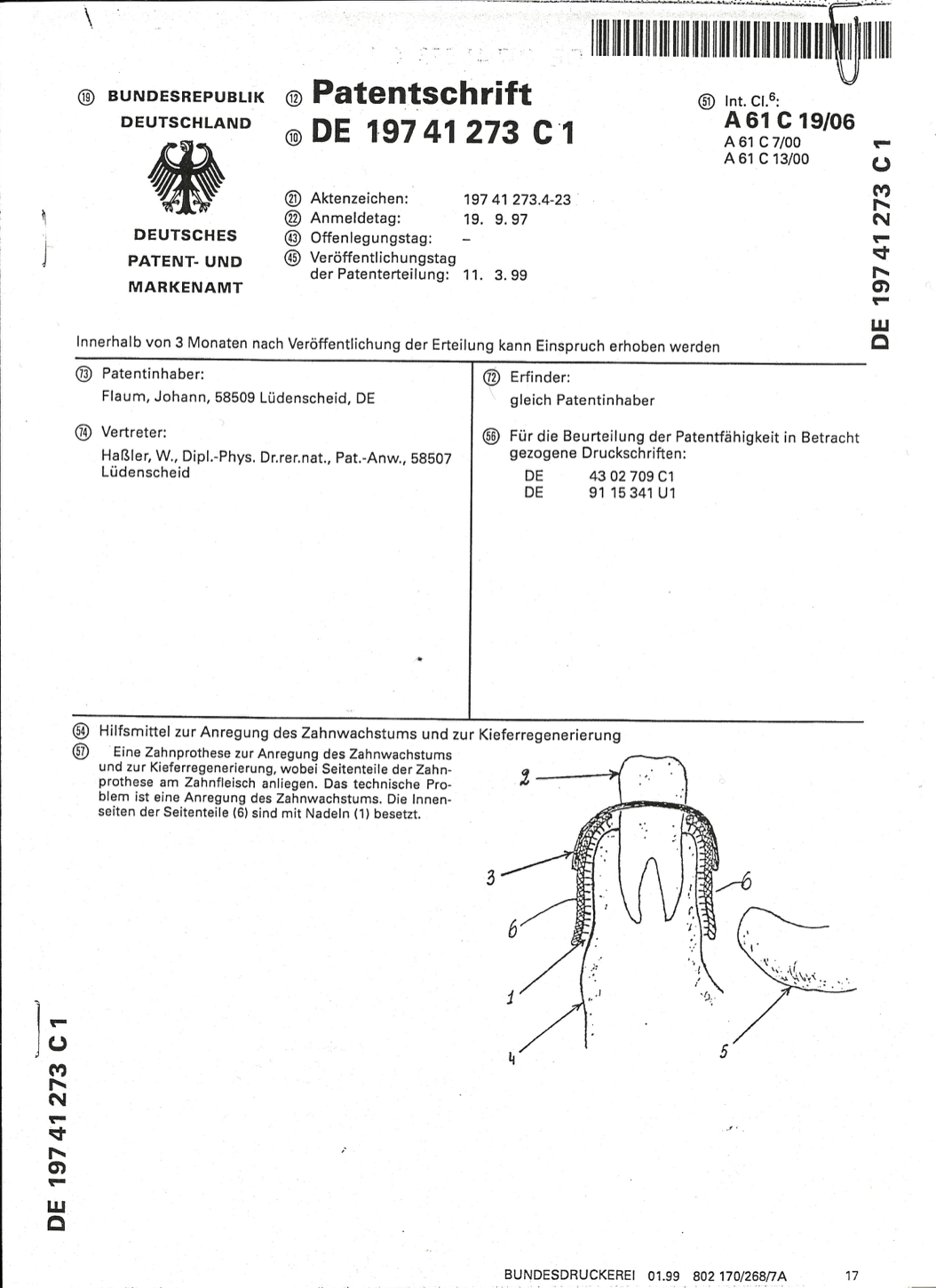
Fig.1 – demonstrates a cross section of the jaw together with the tooth (2).
Jaw (4) is covered with the gum (not explained seperately).
Tooth (2) or remaining part of the tooth serves to secure the brackets (3).
Adjuvant device, whose sides (6) with the help of the brackets (3) are pressed towards each other and are held together.
Sides (6) on each inner surface are studded with needles (1).
Sides (6) cover the entire surface of the gingiva (gums). In the mouth is located the tongue (5).
Needles have an aproximate length of 1 millimetre and an aproximate 1 millimetre distance from one another.
Needles are located on the sides (6) of adjuvant device and are also manufactured from dental prosthetic material.
They also possibly can be manufactured from another material not rejected by the body.
They (needles) should possess sufficient durability, especially the tips of the needles must be durable against fracture (breakage).
Depending on the anatomical structure and following the process of application (implementation) therewith can be chosen another positioning of the needles.
Adjuvant device with needles (1) must be worn for an extended period of time.
Needles (1) stimulate blood circulation in the gingiva (gums) and in the jaw bones.
They activate the remaining parts of the teeth, so that in many cases tooth growth and jaw bone regeneration becomes achieved.
Application may well stretch into several years.
Chewing enhances the action of the needles.
Fig.3 demostrates adjuvant device, wherein tooth (8) is seated on a pin (7) which is rooted in the jaw.
Tooth (8) holds the sides (6). A remaining tooth can itself act as a Pin (7) according to Fig. 4.